Roberto Annecchini
Original language Italian. Translations below in English, French, German.




insiemi di assorbimento x
isolazioni dei ‘se’
= regina huebner
di roberto annecchini, 4 novembre 2018
dalle origini post-espressioniste alle prime evoluzioni su environment installativi (1986 - 1997)
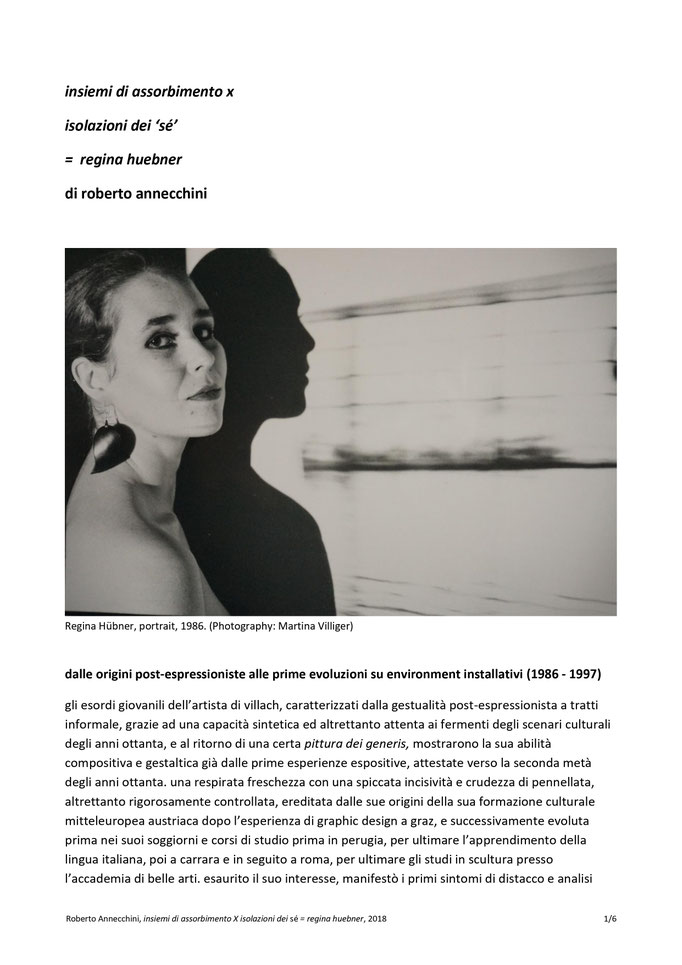
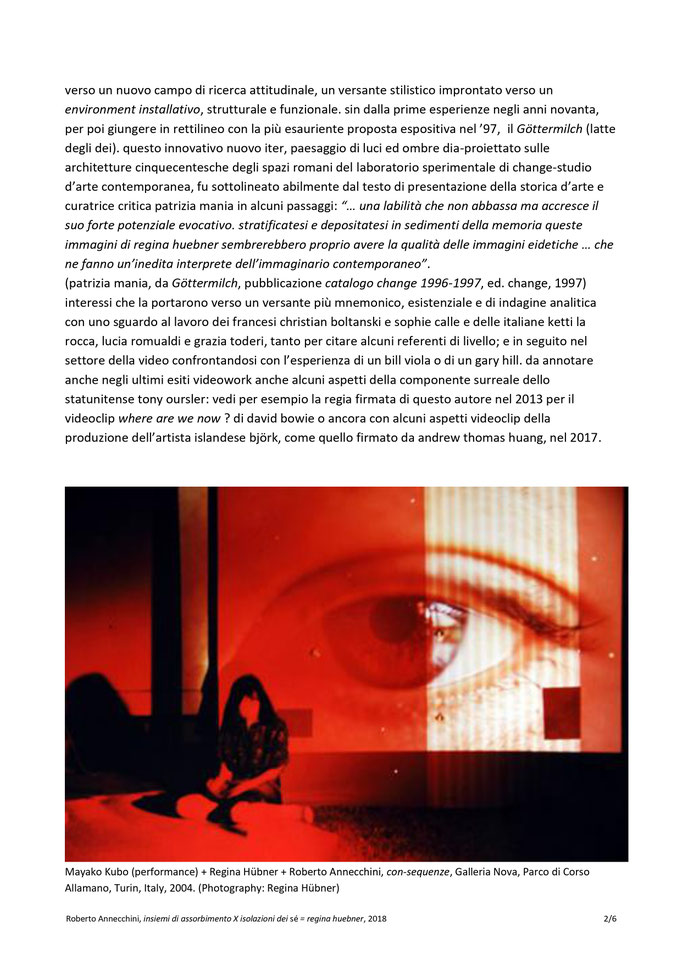
gli esordi giovanili dell’artista di villach, caratterizzati dalla gestualità post-espressionista a tratti informale, grazie ad una capacità sintetica ed altrettanto attenta ai fermenti degli scenari culturali degli anni ottanta, e al ritorno di una certa pittura dei generis, mostrarono la sua abilità compositiva e gestaltica già dalle prime esperienze espositive, attestate verso la seconda metà degli anni ottanta. una respirata freschezza con una spiccata incisività e crudezza di pennellata, altrettanto rigorosamente controllata, ereditata dalle sue origini della sua formazione culturale mitteleuropea austriaca dopo l’esperienza di graphic design a graz, e successivamente evoluta prima nei suoi soggiorni e corsi di studio prima in perugia, per ultimare l’apprendimento della lingua italiana, poi a carrara e in seguito a roma, per ultimare gli studi in scultura presso l’accademia di belle arti. esaurito il suo interesse, manifestò i primi sintomi di distacco e analisi verso un nuovo campo di ricerca attitudinale, un versante stilistico improntato verso un environment installativo, strutturale e funzionale. sin dalla prime esperienze negli anni novanta, per poi giungere in rettilineo con la più esauriente proposta espositiva nel ’97, il “Göttermilch” (latte degli dei). questo innovativo nuovo iter, paesaggio di luci ed ombre dia-proiettato sulle architetture cinquecentesche degli spazi romani del laboratorio sperimentale di change-studio d’arte contemporanea, fu sottolineato abilmente dal testo di presentazione della storica d’arte e curatrice critica patrizia mania in alcuni passaggi: “… una labilità che non abbassa ma accresce il suo forte potenziale evocativo. stratificatesi e depositatesi in sedimenti della memoria queste immagini di regina huebner sembrerebbero proprio avere la qualità delle immagini eidetiche … che ne fanno un’inedita interprete dell’immaginario contemporaneo”. (patrizia mania, da “Göttermilch”, pubblicazione catalogo change 1996-1997, ed. change, 1997). interessi che la portarono verso un versante più mnemonico, esistenziale e di indagine analitica con uno sguardo al lavoro dei francesi christian boltanski e sophie calle e delle italiane ketti la rocca, lucia romualdi e grazia toderi, tanto per citare alcuni referenti di livello; e in seguito nel settore della video confrontandosi con l’esperienza di un bill viola o di un gary hill. da annotare anche negli ultimi esiti videowork anche alcuni aspetti della componente surreale dello statunitense tony oursler: vedi per esempio la regia firmata di questo autore nel 2013 per il videoclip “where are we now ?” di david bowie o ancora con alcuni aspetti videoclip della produzione dell’artista islandese björk, come quello firmato da andrew thomas huang, nel 2017.
metodologie progettuali della sezione diascopica stilistica (1998 - 2008)
animazione, superficie sferiche, interazione con il pubblico, concetti psicologici e filosofici, spazi onirici, luci e registrazione di voci umane, sono le con-sequenze delle proiezioni multimediali video di regina huebner. il metodo progettuale di appartenenza o di disuguaglianza è pertinente per l’approccio di alcuni rari artisti. non sempre le due componenti coincidono e molto spesso artisti anche con un impostazione derivante dal post concettuale non mantengono i presupposti per accreditarsi una metodologia strutturale e costruttiva, sia funzionale o de-funzionale. molto spesso le impostazioni risentono di una caratterizzazione informale ed approssimativa del contenuto e formalmente poverista, così da relazionarsi più ad un “arte povera”, che a concetti più attenti a dinamiche evolutive neo avanguardistiche, sia con sensibile impronta umanista sia con raffinata impronta tecno. regina huebner ha mostrato con coerenza una crescita progressiva nel suo lungo iter di lavoro dando campo di spazio ad una diascopica visione stilistica di metodo, sottraendosi tramite la sua sottile analisi alle facili deviazioni per citazioni gratuite, rimanendo fedele al concetto della sua impostazione, di natura post-concettuale ed anzi continuandone il suo perfezionamento in progressione con contenuti e delicati interventi, sempre più competenti e ricchi di effusioni stilistiche, stimoli culturali, basti pensare alle sue più svariate collaborazioni, con differenti autori di spessore dei vari campi: arti visive, filosofia, letteratura, musica, storia dell’arte, come arnulf rohsmann, fabio cifariello ciardi, luca lombardi, marina corona, mayako kubo, pietro tripodo, roberto annecchini, roberto fabbriciani.
“regina huebner costituisce per queste sue caratteristiche un esempio di vibrante iperrealismo della sensibilità, operando un parossismo segnico attraverso la ridondanza e la reiterazione intenzionale delle acuità sonoro - dinamiche: l’occhio quindi come recettore sensoriale per eccellenza, identità quasi trascendente e luogo di enfasi di ogni cuspide acustica. come ha evidenziato … la visione enfatizzata del dettaglio”. il teorico e storico d’arte domenico scudero nel suo testo critico di presentazione “l’enfasi dello sguardo nel lavoro di regina huebner”, in occasione dell’esposizione presso l’acquario romano, nel 1999, connubio artistico tra il compositore contemporaneo fabio cifariello ciardi e l’artista austriaca regina huebner, e ancor più nel saggio testimoniale proceeding #5, “ … come a volerne spiegare i contenuti più reconditi nei confronti della fisionomia … i suoi segni così distinti sono infatti il definitivo messaggio di individui che non possono mentire.”. (domenico scudero, da “proceeding #5”, pubblicazione “anonymus - regina huebner”, ed. lithos, roma, 2002).
il post - concettualismo aesthetico e l’ornamento costruttivo - funzionale (2009 - 2018)
per post-concettualismo aesthetico si intende una visione di procedura strutturale costruttivo-funzionale, ‘dove’ in parte anche lo specifico ornamento sia oggettuale sia formale, dilatandosi nella distanza, conserva all’idea il ruolo di criticità analitica, sia per presupposti storicistici sia per attualità evolutiva. questa “area aesthetica” in arte si orienta dopo gli sviluppi del post-concettualismo, di una “avanguardia del presente” ed ulteriori tracciati ipercontemporanei evolutivi. questo termine di “area aesthetica” è stato coniugato da me stesso nel 2008, proponendolo già in differenti occasioni espositive di rassegne a frankfurt am main, come: impfstoffe/vaccination, nel 2008, hausgeister, nel 2011, ma soprattutto all’interno della struttura di concetto progettuale di change + partner contemporary art, “www.changeartconcept.com”, nelle sue più svariate forme di rappresentazione, tra il 2008 e il 2018 sia in progetti curatoriali, sia in proposte singole di differenti autori. regina huebner appartiene per interesse e maturazione a questa visione d’insieme, anzi ne è un perno della visione, proprio per il suo risultato qualitativo ottenuto, di interporre la sua coscienza privata di artista all’interno delle dinamiche più ampie ed elaborate del tessuto del concept aesthetico. un viatico che prevede anche l’inclusione di altri autori visivi, come per esempio: anna willieme, augusta atla, dana claxton, dellbruegge & de moll, jane boyd, mathilde ter heijne, roberto annecchini, urs breitenstein …, artisti proposti nel corso degli anni in più occasioni nella piattaforma di www.changeartconcept.com.
“… come proprio peirce dice, il significato della mia vita, di ogni suo atto e gesto, è affidato alla interpretazione degli altri, alle verità che gli altri ne ricaveranno e a ciò che ne faranno. rispetto alla vita vivente di ognuno, la verità pubblica è sempre quel che ne dicono e ne fanno gli altri …”. (carlo sini, da “la verità pubblica e l’archivio della vita”, pubblicazione “anonymus - regina huebner”, ed. lithos, roma, 2002).
conversioni e divergenze. frammentazioni e de- frammentazioni della forma
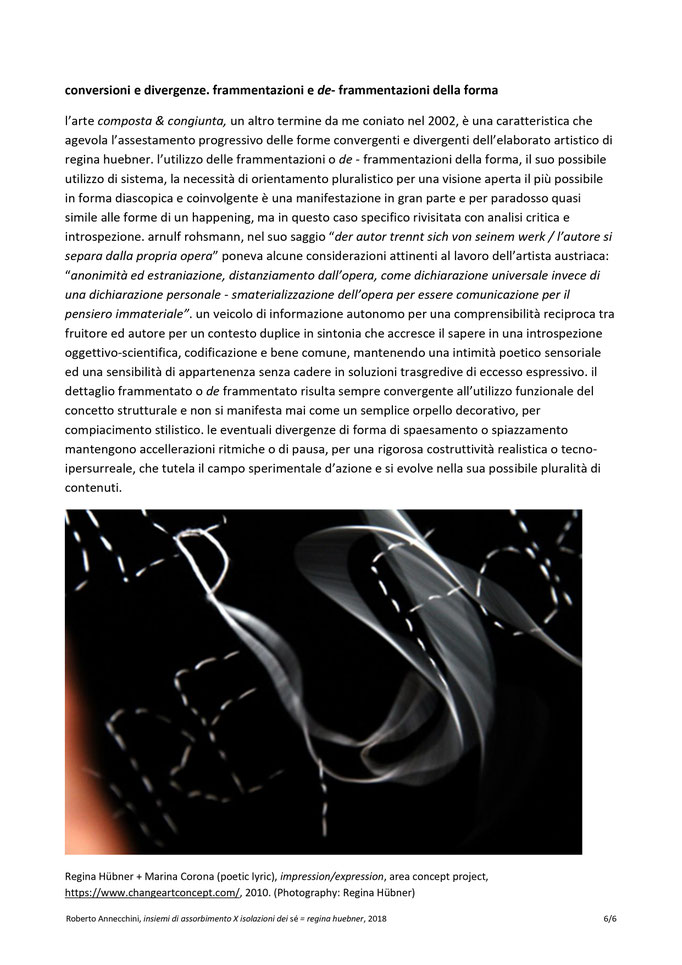
l’arte composta & congiunta, un altro termine da me coniato nel 2002, è una caratteristica che agevola l’assestamento progressivo delle forme convergenti e divergenti dell’elaborato artistico di regina huebner. l’utilizzo delle frammentazioni o de - frammentazioni della forma, il suo possibile utilizzo di sistema, la necessità di orientamento pluralistico per una visione aperta il più possibile in forma diascopica e coinvolgente è una manifestazione in gran parte e per paradosso quasi simile alle forme di un happening, ma in questo caso specifico rivisitata con analisi critica e introspezione. arnulf rohsmann, nel suo saggio “der autor trennt sich von seinem werk / l’autore si separa dalla propria opera” poneva alcune considerazioni attinenti al lavoro dell’artista austriaca: “anonimità ed estraniazione, distanziamento dall’opera, come dichiarazione universale invece di una dichiarazione personale - smaterializzazione dell’opera per essere comunicazione per il pensiero immateriale”. un veicolo di informazione autonomo per una comprensibilità reciproca tra fruitore ed autore per un contesto duplice in sintonia che accresce il sapere in una introspezione oggettivo-scientifica, codificazione e bene comune, mantenendo una intimità poetico sensoriale ed una sensibilità di appartenenza senza cadere in soluzioni trasgredive di eccesso espressivo. il dettaglio frammentato o de frammentato risulta sempre convergente all’utilizzo funzionale del concetto strutturale e non si manifesta mai come un semplice orpello decorativo, per compiacimento stilistico. le eventuali divergenze di forma di spaesamento o spiazzamento mantengono accellerazioni ritmiche o di pausa, per una rigorosa costruttività realistica o tecno-ipersurreale, che tutela il campo sperimentale d’azione e si evolve nella sua possibile pluralità di contenuti.
semantica dell’istanza in progress evolutiva. tempo, spazio, memoria
“tra i molteplici tempi, nei quali si manifesta una determinata circostanza, e che essa contribuisce ad installare, regina huebner ha isolato tre ambiti problematici:
il tempo presente psichico
temps / durèe e
la relazione con l’entropia nei sistemi chiusi.
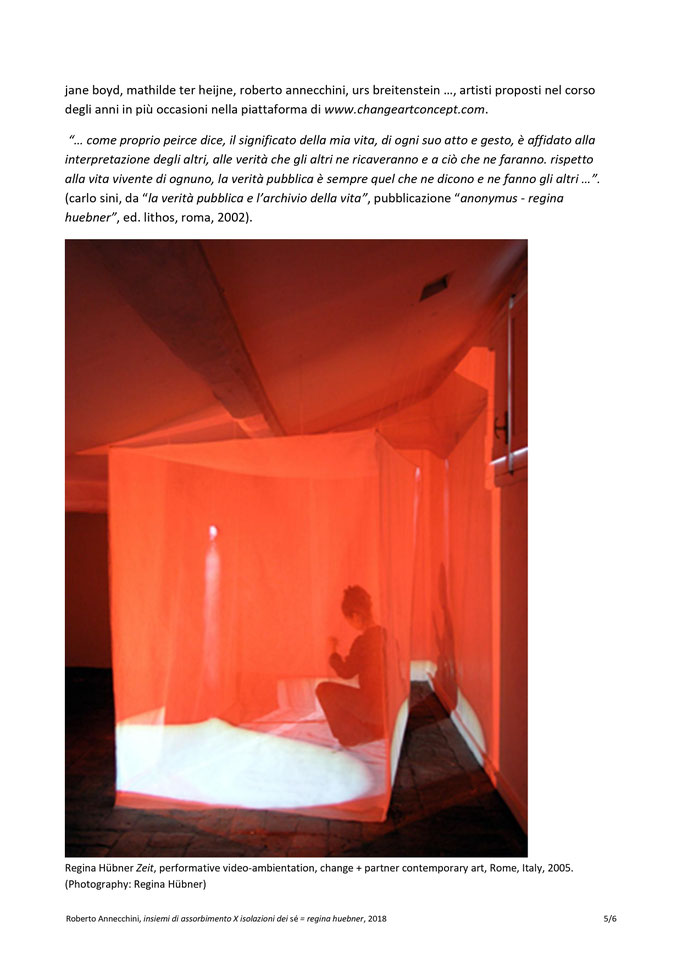
a questi si aggiunge inoltre, se la trasposizione iconografica viene effettuata con l’aiuto di un medium avanzato come il video all’interno di un ambiente storico, anche il confronto fra due livelli temporali. ….”. (arnulf rohsmann, da “regina huebner/zeit”, per “Zeit”, solo show di regina huebner presso change + partner contemporary art, roma, 2005, pubblicazione catalogo change + partner 2001 - 2005, ed. change + partner, roma, 2005). il valore dell’ordinamento della transizione grammaticale del transfert concettuale si assesta e si radica nell’evolversi del tempo dello spazio e della memoria trasferendo in progress gli eventuali apporti di apprendimento sia sociali sia privati, dove il pubblico da spettatore diventa il soggetto principale della sostanza critica dell’ìdentità semantica. la progressione e l’espansione del concetto di pensiero mantiene alla metodologia progettuale del lavoro la caratteristica di alterità e adattamento in connubio ed una attenzione all’interlocutore sempre in sincronia dialettica oltre che di reciproco apprendimento. esempi di questo tipo di cognizioni di orientamento, sempre a forte spessore analitico sono proprio quelli di differenti lavori dell’artista di villach, da mensionare: le collaborazioni per “con-sequenze”, (solo show) 1994/1995, con mayako kubo e roberto annecchini, “annecchini – huebner”, (solo show) 1996, presso change-studio d’arte contemporanea, roma “
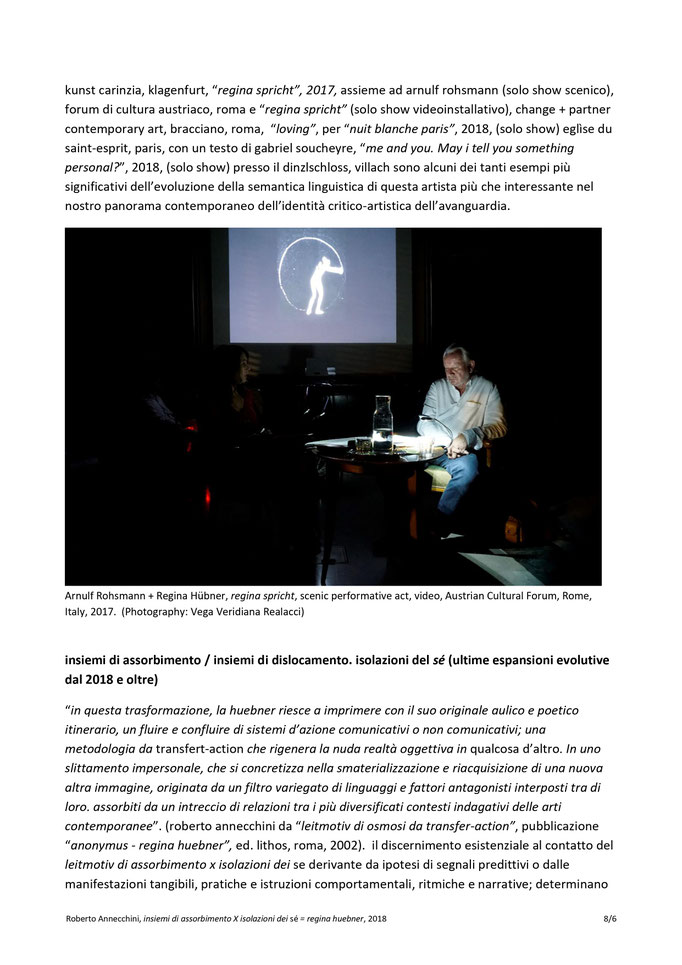
“Erinnerungen per Games”, (solo show) 1998 con fabio cifariello ciardi, acquario romano, roma, “day by day”, 1999, (project group show) assieme a roberto annecchini, presso change-studio d’arte contemporanea, roma. ricca la produzione videoworks e videoproiettiva come “possibilities”’, 2001, (project group show) mlac-museo laboratorio di arte contemporanea dell’università degli studi “la sapienza” , roma, in occasione del progetto di domenico scudero e roberto annecchini “utilità di sistema”, “ich denke an” , 2002, (project group show) change-studio d’arte contemporanea, roma, in occasione del progetto di roberto annecchini “surplace”, “anonymous dedicated to vally”, (solo show) 2002-2004, presso mlac-museo laboratorio di arte contemporanea dell’università degli studi “la sapienza”, roma, 2002 e presso oratorio san ludovico / nuova icona, venezia, 2004, “Zei”’, 2005, (solo show) change + partner contemporary art, con un testo di arnulf rohsmann, “touch”, 2007, (project group show) change + partner contemporary art, roma in occasione del progetto di roberto annecchini “settlement and nemesis” e presso la personale al palazzo delle scienze, eur, roma, “impression/expression”, 2010, (solo show) in collaborazione con la poetessa marina corona per la culturale piattaforma contemporanea di change + partner, curata e diretta da roberto annecchini, www.changeartconcept.com, “connecting times”, 2014, (project group show), per il progetto di roberto annecchini “organigramma x ontologia/x ontology organizatio”’, “loving”, 2016, (project group show) presentato allo zkm-zentrum für kunst und medien, karlsruhe, germania, per “time is love 10”, international video program curated by kisito assangni, “Terra with happen und unhappen” by regina huebner, luca lombardi, 2016, (solo show) istituto italiano culturale vienna “time and person”, 2016, (solo show) mmkk-museo modern kunst carinzia, klagenfurt, “regina spricht”, 2017, assieme ad arnulf rohsmann (solo show scenico), forum di cultura austriaco, roma e “regina spricht” (solo show videoinstallativo), change + partner contemporary art, bracciano, roma, “loving”, per “nuit blanche paris”, 2018, (solo show) eglìse du saint-esprit, paris, con un testo di gabriel soucheyre, “me and you. May i tell you something personal?”, 2018, (solo show) presso il dinzlschloss, villach sono alcuni dei tanti esempi più significativi dell’evoluzione della semantica linguistica di questa artista più che interessante nel nostro panorama contemporaneo dell’ identità critico-artistica dell’avanguardia.
insiemi di assorbimento / insiemi di dislocamento. isolazioni del se (ultime espansioni evolutive dal 2018 e oltre)
“in questa trasformazione, la huebner riesce a imprimere con il suo originale aulico e poetico itinerario, un fluire e confluire di sistemi d’azione comunicativi o non comunicativi; una metodologia da transfert-action che rigenera la nuda realtà oggettiva in qualcosa d’altro. In uno slittamento impersonale, che si concretizza nella smaterializzazione e riacquisizione di una nuova altra immagine, originata da un filtro variegato di linguaggi e fattori antagonisti interposti tra di loro. assorbiti da un intreccio di relazioni tra i più diversificati contesti indagativi delle arti contemporanee”. (roberto annecchini da “leitmotiv di osmosi da transfer-action”, pubblicazione “anonymus - regina huebner”, ed. lithos, roma, 2002). il discernimento esistenziale al contatto del leitmotiv di assorbimento x isolazioni dei se derivante da ipotesi di segnali predittivi o dalle manifestazioni tangibili, pratiche e istruzioni comportamentali, ritmiche e narrative; determinano l’espressione di stabilità d’insiemi dislocati con differenti metodologie sinergiche. quest’ultime sono l’apparato elaborato da regina huebner che si confronta con l’attitudine dell’altro per distanziarsi dalla preponderanza dell’atto creativo, e il restituire al singolo interlocutore il valore dell’essere. giacenze come matrici e virtù epidermiche sono isolazioni del se che si confrontano con appropriato carattere in un equilibrio di opposti per soluzioni d’insiemi introspettivi a più largo spessore e visibilità percettiva per un’identità critico e artistica. il transfert sistematico improntato da regina huebner determina una “fuori onda”, testimoniale e scenica, che si dilata e si restringe consentendo all’autocoscienza il possibile approccio osmotico per l’evoluzione progettuale. “me and you. May I tell you something personal?”, ne è l’esempio progettuale più recente, attuale ed esauriente proposto a villach nel 2018, per la sua retrospettiva/introspettiva presso il dinzlschloss, dove i termini e gli inserimenti insiemistici di caratterizzazione quasi matematica ne alterano gli standard visivi da lei realizzati per porsi alla riqualificazione del tessuto critico artistico volto a una sperimentazione ipercontemporanea del presente e avanguardia della “poetica aesthetica”. “if you can fill the unforgiving minute” (joseph rudyard kipling).
Roberto Annecchini, 4 November 2018
Roberto Annecchini (4.11.1962 - 7.11.2018)
Visual artist, concept performer, art critical curator, gallerist, poet, writer. Since December 1996 director and art critical curator of the avangarde space “change + partner contemporary art” in Rome and Bracciano, Italy, with the special “concept project”, which was founded and invented by him.
Website change + partner contemporary art: https://www.changeartconcept.com/
Website Roberto Annecchini: https://www.robertoannecchini.it/
English translation
roberto annecchini
sets of absorptions x
isolations of “selves”
= regina huebner
post-expressionist origins to early developments in setting up multimedia spaces (1986 - 1997)
the first steps of the young artist from villach, characterized by the sometimes informal post-expressionist gesture, thanks to an ability for synthesis all the while remaining attentive to the agitations of the cultural circles of the 80s, and a return to a certain pittura dei generis (painting of genres), demonstrated her ability to compose and give formal structure starting with her first exhibitions, officially going back to the second half of the 80s. a powerful originality with impactful sharpness and hardness of stroke, also rigorously mastered, inherited from the beginning of her austrian cultural training following the experience gained in the field of graphic design in graz, then evolving during her stays and study in perugia, in order to finish learning italian, then to carrara and rome later on to finish her studies in sculpture at the academy of fine arts. her interest coming to an end, she showed the first signs of detachment and analysis, pivoting to a new field of behavioural research, a stylistic universe oriented towards an environment installativo, the installation of structural and functional multimedia spaces. this from her first experiences in the 90s and then directly, in 1997, to a more conclusive exhibition: the Göttermilch (milk of the gods). this new innovative journey, a landscape made of shadows and lights projected on the architecture of sixteenth century roman spaces of the experimental laboratory of change - studio d’arte contemporanea, was cleverly highlighted in some passages through the introductory text by the art historian and curator patrizia mania “… an evanescence that does not weaken but intensifies its strong evocative potential. these images by regina hübner, after being stratified and deposited like sediments of memory, would really seem to have the quality of eidetic images ... which make them an unprecedented interpreter of the contemporary imagination.”
(patrizia mania, extract from Göttermilch, publication catalogo change 1996-1997, ed. change, 1997.)
centers of interest took her to a more mnemonic and existential universe, and to analytical investigation, influenced by the work of the french artists christian boltanski and sophie calle and the Italians ketti la rocca, lucia romualdi and grazia toderi, to name only a few recognized references; then in the world of video, allowing her to compare herself to the experience of a bill viola or a gary hill. also noteworthy in the last video releases are some aspects of the surreal component of the american tony oursler: see for example the production in 2013 by this author for the video clip Where Are We Now? by david bowie or some aspects of video clips produced by the icelandic artist björk, like the one in 2017 by andrew thomas huang.
planning methodologies of the stylistic diascopic section (1998 - 2008)
animation, spherical surfaces, interaction with the audience, psychological and philosophical concepts, dreamlike spaces, lights and recording of human voices constitute a con-sequences (series of sequences) of multimedia video projections by regina huebner. the conceptual method of belonging or of difference is relevant to a few rare artists. the two components do not always coincide and very often, artists even with an approach deriving from post-conceptualism do not respect the fundamentals, in order to acquire a structural and constructive methodology, both functional and de-functional. very often, the approach is influenced by an informal and approximate characterization of the content and formally belong to “arte povera”, to the point of entering more in touch with the latter than with concepts more oriented towards neo-avant-garde evolutionary dynamics, marked with a considerably humanist touch as well as refined techno. regina huebner has coherently shown a growing progression in her overall professional career, giving scope to a methodically stylistic diascopic vision, freeing herself from easy shortcuts allowing her to be quoted freely thanks to her subtle analysis, remaining faithful to the concept of her guiding principles, of a post-conceptual nature and even pursuing her increasing perfection with content and meticulous interventions, with more and more expertise, rich in “stylistic outpourings”, and cultural workings. just think of her many different collaborations, alongside various important authors working in diverse fields such as visual arts, philosophy, literature, music, art history, such as arnulf rohsmann, fabio cifariello ciardi, luca lombardi, marina corona, mayako kubo, pietro tripodo, roberto annecchini, roberto fabbriciani.
“through her characteristics, regina hübner is a vibrant example of hyperrealism of sensitivity, provoking a semiotic paroxysm through the redundancy and repetition of audio-dynamic acuities: the eye thus becomes the sensorial receptor par excellence, an almost transcendent identity and place of emphasis of any acoustic peak. …” as was highlighted “… the increased vision of detail.” by the theoretician and art historian domenico scudero in his review L’enfasi dello sguardo nel lavoro di Regina Hübner (The accentuation of the regard in the work of Regina Hübner), for the exhibition at the acquario romano (Roman Aquarium), in 1999, an artistic collaboration between the contemporary composer fabio cifariello ciardi and the austrian artist regina hübner, and even more in his testimonial essay proceeding #5, “…as if she wanted to explain the most secret content with regard to physiognomy ... these signs, so distinct, constitute the definitive message of individuals who cannot lie.” (domenico scudero, excerpt from proceeding #5, publication Anonymus - Regina Hübner, ed. lithos, rome, 2002.)
aesthetic post-conceptualism and constructive-functional ornamentation (2009-2018)
by aesthetic post-conceptualism, we mean a structural procedural vision of functional construction, “where” the specific ornament, both object and formal, expanding through distance, also keeping partly in mind the role of analytical critique, for principles peculiar to historicism as well as for evolutionary actuality. this “area aesthetica” finds its way into the field of art following the advances of post-conceptualism, an “avant-garde of the present” and other hyper contemporary evolutionary paths. this term “area aesthetica” was coined by myself in 2008, already presenting it as part of different exhibitions in frankfurt am main, such as impfstoffe/vaccination, in 2008, hausgeister, in 2011, but especially within the structure of conceptual project relating to change + partner contemporary art, “www.changeartconcept.com”, in its most diverse forms of representation, between 2008 and 2018, both in projects developed by curators and in the context of individual proposals by different authors. regina huebner belongs, through her interest and experience, to this overall vision and is even a basic element, precisely because of her results obtained in qualitative terms to introduce her own artistical consciousness into more extensive and elaborate dynamics of the concept aesthetico fabric. a viaticum that also provides for the inclusion of other visual artists, for example: anna willieme, augusta atla, dana claxton, dellbruegge & de moll, jane boyd, mathilde ter heijne, roberto annecchini, urs breitenstein, ..., artists presented several times over the years on the site www.changeartconcept.com.
“...as peirce says, the meaning of my life, all of its deeds and actions, is delivered to the interpretation of others, to the truths they will derive from it and to what they will do with it. in relation to everyone’s current life, public truth is always what others say and do...”. (carlo sini, excerpt from La verità pubblica e l’archivio della vita (The public truth and the archive of life), publication Anonymus - Regina Hübner, lithos ed., rome, 2002).
conversions and divergences. fragmentation and de-fragmentation of form
composta & congiunta (composed and combined) art, another term i coined in 2002, has the characteristic of facilitating the progressive union of the convergent and divergent forms resulting from the artistic production of regina huebner. the use of fragmentations or de-fragmentations of the form, its possible systemic use, the need for plural orientation for the widest possible vision in diascopic and lively form is an almost similar manifestation, in large part and in a paradoxical way, to the forms of a happening but revisited in this specific case by means of critical analysis and introspection. arnulf rohsmann, in his essay der autor trennt sich von seinem werk (the author separates himself from his work), reflected on the connection with the work of the austrian artist: “anonymous character and isolation, distance from the work, as a universal declaration rather than personal statement - dematerialization of the work to promote immaterial thought...”. an autonomous vector of information for reciprocal intelligibility between the user and the author, for a dual harmonious context that increases knowledge within the framework of an objective scientific introspection, codification and common good, preserving a poetic sensorial intimacy and a sense of belonging without being resigned to transgressive solutions of excessive expression. the fragmented or de-fragmented detail always contributes to the functional use of the structural concept and never manifests itself as a semblance of decoration, for the pleasure of style. the possible differences of disorientation or displacement maintain accelerations of rhythm or pauses, for a rigorous realistic or techno-hyper-surreal construction, which preserves the experimental field of action and evolves in its possible plurality of content.
semantics of the evolving instance. time, space, memory
“among the multiple times, during which a given circumstance takes shape, and which it contributes to set up, regina hübner identified three research frameworks:
the psychic present time
time / duration and
the relation to entropy in closed systems.
furthermore, if the iconographic transposition is carried out using advanced media like video within a historical environment, the comparison between two temporal scales can also be added...”. (arnulf rohsmann, excerpt from regina hübner/zeit, for Zeit (Time), personal exhibition by regina huebner for change + partner contemporary art, rome, 2005, publication catalogue change + partner 2001 - 2005, ed. change + partner, rome, 2005).
the value of the organization of the grammatical transition of the conceptual transfer is adjusted and fixed over time, space and memory, transferring during the course of events the possible social as well as private learning contributions, where the audience as a spectator becomes the main subject of the critical substance of semantic identity. the progression and diffusion of the concept of thought allows the conceptual methodology of the work to preserve a characteristic of alterity and adaptation in union as well as an attention paid to the interlocutor which is always in dialectical synchrony as well as reciprocal learning. examples of this type of orientation knowledge, always of strong analytic depth, are precisely those of the various works carried out by the villach artist, including: collaborations for con-sequenze, (solo exhibition) 1994/1995, with mayako kubo and roberto annecchini, annecchini - hübner, (solo exhibition) 1996, at the change-studio d’arte contemporanea, rome; Erinnerungen per Games, (solo show) 1998 with fabio cifariello ciardi, acquario romano (Roman Aquarium), rome; day by day, 1999, (group show) with roberto annecchini, at the change - studio d’arte contemporanea, rome. rich production of video work and video projections like possibilities, 2001, (project group show) mlac - museum contemporary art laboratory of the university la sapienza, rome, for the project by domenico scudero and roberto annecchini utilità di sistema; ich denke an… , 2002, (project group show) change - studio d’arte contemporanea, rome, for the project by roberto annecchini surplace; Anonymus dedicated to Vally, (solo show) 2002-2004, at mlac - museum contemporary art laboratory of the university la sapienza, rome, 2002 and at the oratory san ludovico / nuova icona, venice 2004; Zeit, 2005, (solo show) change + partner contemporary art, along with a text by arnulf rohsmann; touch, 2007, (project group show) change + partner contemporary art, rome for the project by roberto annecchini settlement and nemesis and in the solo show at the palace of sciences, eur, rome; impression/expression, 2010, (solo show) in collaboration with the poetess marina corona for the contemporary art platform of change + partner, produced and directed by roberto annecchini, www.changeartconcept.com; connecting times, 2014, (group show), for the project by roberto annecchini organigramma x ontologia / x ontology organization; loving, 2016, (group show) presented at the zkm-centre of arts and media, karlsruhe, germany, for time is love 10, international video program directed by kisito assangni; Terra with happen and unhappen by regina huebner, luca lombardi, 2016, (solo show); italian cultural institute, vienna; time and person, 2016, (solo show), mmkk - modern art museum, carinthia, Klagenfurt with the scenic dialogue regina spricht together with arnulf rohsmann; regina spricht, 2017, with arnulf rohsmann (solo theatrical show), austrian cultural forum, rome; regina spricht (solo theatrical show, video installation), change + partner contemporary art, bracciano, rome; loving, nuit blanche paris 2018, église du saint-esprit, paris (solo show), accompanied by the text by gabriel soucheyre; me and you - May I tell you something personal?, 2018, (solo show) dinzlschloss, villach, austria; are some of the most significant examples of the evolution of the linguistic semantics of this artist who is more than interesting in our contemporary panorama of the avant-garde critical artistic identity.
sets of absorptions / series of dislocation, isolations of oneself (latest evolutionary developments from 2018 and beyond)
“in this transformation, huebner manages to give free rein and converge, thanks to the originality of her original and poetic journey, communicative or non-communicative action systems; a methodology similar to a transfer-action (action of transmission) which regenerates the plain objective reality into something different. in an impersonal shift, which is concretized through the dematerialization and reacquisition of a new, different image, born of a varied prism of languages and antagonistic factors interposed between them. absorbed by an entanglement of relationships among the most di verse contexts of study in contemporary arts”. (roberto annecchini, excerpt from leitmotiv di osmosi da transfer-action, publication Anonymus - Regina Hübner, ed. lithos, rome, 2002). the existential discernment in contact with the leitmotiv di assorbimento x isolazioni dei “sè” (leitmotiv of absorption for isolations of “selves”) deriving from hypotheses of premonitory signs or tangible manifestations, and behavioural, rhythmic, and narrative practices and instructions: they define the expression of stability of disrupted series using different synergistic methodologies. these constitute the system developed by regina huebner who confronts the attitude of others in order to take a step back from the preponderance of the creative act and restore the value of existence to each interlocutor. unresolved periods as matrices and epidermal virtues constitute isolations of the self that are appropriately compared in an equilibrium of opposites for solutions of introspective series of greater consistency and perceptual visibility for a critical and artistic identity. the systematic transfer, developed by regina huebner, determines a testimonial and scenic “fuori onda” (off-air), that expands and shrinks allowing self-awareness a possible osmotic approach for conceptual evolution. me and you - May I tell you something personal? is the most recent, current and conclusive conceptual example proposed in villach in 2018, for her retrospective / introspection at dinzlschloss, where the terms and quasi-mathematical sets of insertions modify the visual standards that she has developed, in order to devote herself to the requalification of the artistic critical fabric aimed at a hyper contemporary experimentation of the present and avant-garde of the “poetica aesthetica” (poetic aesthetic). “if you can fill the unforgiving minute” (joseph rudyard kipling).
insiemi di assorbimento x isolazioni dei ‘se’ = regina huebner, roberto annecchini, 4 november 2018.
Posthumous, first publication French and English in Turbulences Vidéo #102 / VIDEOFORMES, 2019.
Roberto Annecchini (04/11/1962 – 11/11/2018), visual artist, concept performer, art critical curator, gallerist, poet, writer. Since December 1996 director and art critical curator of the avantgarde space change + partner contemporary art in Rome and Bracciano, Italy, with the special “concept project”, which he founded and invented.
First Publication, posthumously: TURBULENCES #102, 2019, ed. Turbulences Video / Digital & Hybrid Arts, Clermont-Ferrand,France.
Translation: VIDEOFORMES
French translation
roberto annecchini
ensembles d’absorption x isolements des "sois" = regina huebner
des origines post expressionnistes aux premières évolutions dans les installations d’espaces multimédia (1986 - 1997)
les premiers pas de la jeune artiste originaire de Villach, caractérisés par la gestuelle post-expressionniste quelquefois informelle, grâce à une capacité de synthèse tout en étant attentive aux agitations des milieux culturels des années 80, et au retour d’une certaine pittura dei generis (peinture des genres), démontrèrent son aptitude à composer et à donner une structure formelle dès ses premières expositions, remontant officiellement à la deuxième moitié des années 80. une originalité puissante dotée d’une netteté tranchante et dureté de trait, également maîtrisée de manière rigoureuse, héritée dès le départ de sa formation culturelle autrichienne suite à l’expérience acquise dans le domaine du design graphique à graz, évoluant ensuite lors de ses séjours et cursus d’études à pérouse dans un premier temps, afin d’achever l’apprentissage de la langue italienne, puis à carrare et rome par la suite afin de terminer ses études en sculpture à l’académie des beaux-arts. son intérêt prenant fin, elle manifesta des premiers signes de recul et d’analyse tournée vers un nouveau domaine de recherche comportementale, un univers stylistique orienté vers l’installation d’espaces multimédia, structurels et fonctionnels. cela dès ses premières expériences dans les années 90 pour aboutir ensuite en ligne directe, en 1997, à une offre d’exposition plus concluante : le Göttermilch (lait des dieux). ce nouveau parcours innovant, paysage fait d’ombres et lumières projetées en diapositives sur les architectures du XVIe siècle des espaces romains du laboratoire expérimental de change - studio d’arte contemporanea, fut habilement mis en avant dans certains passages par le texte de présentation de l’historienne d’art et commissaire critique patrizia mania : “… une évanescence qui n’affaiblit pas mais accroît son fort potentiel évocateur. Ces images de regina hübner, après s’être stratifiées et déposées tels des sédiments de la mémoire, sembleraient vraiment disposer de la qualité des images eidétiques... lesquelles en font une interprète inédite de l’imaginaire contemporain”. (patrizia mania, extrait de Göttermilch, publication catalogue change 1996-1997, ed. change, 1997.) des centres d’intérêts qui l’emmenèrent dans un univers plus mnémonique, existentiel et d’enquête analytique, le regard tourné vers le travail des français christian boltanski et sophie calle et celui des Italiennes ketti la rocca, lucia romualdi et grazia toderi, pour ne citer que quelques référents reconnus; puis dans le monde de la vidéo, lui permettant de se mesurer à l’expérience d’un bill viola ou d’un gary hill. A noter également dans les dernières sorties de travaux vidéo quelques aspects de la composante surréelle de l’américain tony oursler : voir par exemple la mise en scène signée en 2013 par cet auteur pour le clip vidéo Where Are We Now? de david bowie ou encore quelques aspects de clips vidéo produits par l’artiste islandaise björk, comme celui signé en 2017 par andrew thomas huang.
méthodologies conceptuelles de la section diascopique stylistique (1998 - 2008)
animation, surfaces sphériques, interaction avec le public, concepts psychologiques et philosophiques, espaces oniriques, lumières et enregistrement de voix humaines constituent une ʺcon-sequenzeʺ (enchaînement de séquences) des projections vidéo multimédia de regina huebner. la méthode conceptuelle d’appartenance ou de différence est pertinente au regard de quelques rares artistes. les deux composantes ne coïncident pas toujours et très souvent, des artistes ayant même une ligne directrice dérivant du post-conceptuel ne respectent pas les fondamentaux, afin d’acquérir une méthodologie structurelle et constructive, aussi bien fonctionnelle que dé-fonctionnelle. très souvent, les lignes directrices subissent l’influence d’une caractérisation informelle et approximative du contenu et relevant formellement de l'arte povera, au point d’entrer davantage en rapport avec ce dernier qu’avec des concepts plus tournés vers les dynamiques évolutives néo-avant-gardistes, aussi bien empreintes d’une touche sensiblement humaniste que techno raffinée. regina huebner a montré de manière cohérente une progression croissante dans son parcours professionnel au long cours, en donnant du champ à une vision diascopique stylistique méthodique, en s’affranchissant des contournements faciles lui permettant d’être citée gratuitement grâce à son analyse subtile, restant fidèle au concept de sa ligne directrice, de nature post-conceptuelle et poursuivant même son perfectionnement croissant avec des contenus et des interventions soignés, de plus en plus experts et riches en ʺeffusions stylistiquesʺ, ressorts culturels. pensons simplement à ses collaborations les plus diverses, aux côtés de différents auteurs importants œuvrant dans divers domaines tels que les arts visuels, la philosophie, la littérature, la musique, l’histoire de l’art, comme arnulf rohsmann, fabio cifariello ciardi, luca lombardi, marina corona, mayako kubo, pietro tripodo, roberto annecchini, roberto fabbriciani.
“de par ses caractéristiques, regina hübner constitue un exemple vibrant d’hyperréalisme de la sensibilité, provoquant un paroxysme sémiotique à travers la redondance et la répétition des acuités audio-dynamiques : l’œil devient ainsi le récepteur sensoriel par excellence, identité quasi transcendante et lieu d’emphase de tout pic acoustique". comme l’a souligné la vision accrue du détail le théoricien et historien de l’art domenico scudero dans son texte critique de présentation l’enfasi dello sguardo nel lavoro di regina hübner (l’accentuation du regard dans le travail de regina hübner), à l'occasion de l’exposition à l’aquarium romain, en 1999, collaboration artistique entre le compositeur contemporain fabio cifariello ciardi et l’artiste autrichienne regina hübner, et davantage encore dans son essai témoignage proceeding #5, “...comme si elle voulait en expliquer les contenus les plus secrets à l’égard de la physionomie... ces signes si distincts constituent en effet le message définitif d’individus qui ne peuvent mentir.”. (domenico scudero, extrait de proceeding #5, publication Anonymus - Regina Hübner, ed. lithos, rome, 2002.)
Le post-conceptualisme esthétique et l’ornement fonctionnel de construction (2009-2018)
par post-conceptualisme esthétique, on entend une vision de procédure structurelle de construction fonctionnelle, ʺoùʺ l’ornement spécifique aussi bien objectal que formel, se dilatant sur la distance, garde également à l’esprit en partie le rôle de ʺcritique analytiqueʺ, aussi bien pour des principes propres à l’historicisme que pour l’actualité évolutive. cette area aesthetica trouve son chemin dans le domaine de l’art suite aux avancées du post-conceptualisme, d’une “avant-garde du présent” et d’autres parcours hyper contemporains évolutifs. ce terme area aesthetica a été inventé par moi-même en 2008, le proposant déjà dans le cadre de différentes expositions à frankfurt am main, comme Impfstoffe/vaccination, en 2008, Hausgeister, en 2011, mais surtout à l'intérieur de la structure de concept relatif au projet change + partner contemporary art, www.changeartconcept.com, dans ses formes de représentation les plus diverses, entre 2008 et 2018, aussi bien dans des projets élaborés par des commissaires que dans le cadre de propositions individuelles de différents auteurs. regina huebner appartient, de par son intérêt et son expérience, à cette vision d’ensemble et en est même un élément de base, en raison précisément de son résultat obtenu en terme qualitatif d'introduire sa propre conscience d’artiste au sein de dynamiques plus amples et élaborées du tissu du concept aesthetico. Un viatico (viatique) prévoyant également l’inclusion d’autres auteurs d’arts visuels, comme par exemple : anna willieme, augusta atla, dana claxton, dellbruegge & de moll, jane boyd, mathilde ter heijne, roberto annecchini, urs breitenstein, ... artistes proposés au fil des ans à plusieurs reprises sur la plateforme du site www.changeartconcept.com.
“…comme le dit peirce même, le sens de ma vie, de tous ses faits et gestes, est livré à l'interprétation des autres, aux vérités qu’ils en retireront et à ce qu'ils en feront. Par rapport à la vie en cours de chacun, la vérité publique est toujours ce qu’en disent et en font les autres…”. (carlo sini, extrait de La verità pubblica e l’archivio della vita (La vérité publique et l’archive de la vie), publication Anonymus - Regina Hübner, ed. lithos, rome, 2002).
conversions et divergences. fragmentations et dé-fragmentations de la forme
l’art composta & congiunta (composé et uni), un autre terme de mon invention forgé en 2002, a pour caractéristique de faciliter l’union progressive des formes convergentes et divergentes issues de la production artistique de regina huebner. l’utilisation des fragmentations ou dé-fragmentations de la forme, sa possible utilisation systémique, la nécessité d’orientation plurielle pour une vision la plus large possible sous forme diascopique et entraînante est une manifestation quasi semblable, en grande partie et de manière paradoxale, aux formes d’un happening mais revisitée dans ce cas spécifique au moyen d’une analyse critique et de l’introspection. arnulf rohsmann, dans son essai der autor trennt sich von seinem werk (l’auteur se sépare de son œuvre) émettait quelques considérations en rapport avec le travail de l’artiste autrichienne : “caractère anonyme et isolement, distanciation à l’égard de l’oeuvre, comme déclaration universelle plutôt que déclaration personnelle - dématérialisation de l’oeuvre afin de promouvoir la pensée immatérielle. …”. un vecteur d'information autonome pour une intelligibilité réciproque entre l’usager et l’auteur, pour un contexte harmonieux de couple qui accroît sa connaissance dans le cadre d’une introspection objective scientifique, codification et bien commun, préservant une intimité poétique sensorielle et un sentiment d’appartenance sans se résigner à des solutions transgressives d’expression démesurée. le détail fragmenté ou dé-fragmenté concourt toujours à l’utilisation fonctionnelle du concept structurel et ne se manifeste jamais comme un semblant de décoration, pour le plaisir du style. les divergences éventuelles de forme de dépaysement ou de prise à contre-pied maintiennent des accélérations de rythme ou des pauses, pour une rigoureuse construction réaliste ou techno-hyper-surréelle, qui préserve le champ d’action expérimental et évolue dans sa possible pluralité de contenus.
sémantique de l’instance en cours évolutive. temps, espace, mémoire
“parmi les temps multiples, durant lesquels prend forme une circonstance donnée, et que celle-ci contribue à mettre en place, regina hübner a identifié trois cadres problématiques :
le temps présent psychique
temps / durée et
le rapport à l’entropie dans les systèmes clos.
à celui-ci s’ajoute également, si la transposition iconographique est effectuée à l’aide d’un média avancé comme la vidéo au sein d’un environnement historique, la comparaison entre deux échelles temporelles. ….”. (arnulf rohsmann, extrait de regina hübner/zeit, pour Zeit (temps), exposition personnelle de regina huebner à change + partner contemporary art, rome, 2005, publication catalogue change + partner 2001 - 2005, ed. change + partner, rome, 2005). la valeur de l’organisation de la transition grammaticale du transfert conceptuel s’ajuste et s’ancre au fil du temps, de l’espace et de la mémoire, transférant en cours d’évènements les apports éventuels d’apprentissage aussi bien sociaux que privés, où le public en tant que spectateur devient le sujet principal de la substance critique de l’identité sémantique. la progression et la diffusion du concept de pensée permet à la méthodologie conceptuelle du travail de conserver une caractéristique d’altérité et d’adaptation en union ainsi qu’une attention portée à l’interlocuteur toujours en coïncidence dialectique, indépendamment de l’apprentissage réciproque. des exemples de ce type de notions d’orientation, toujours à forte consistance analytique, sont justement ceux des différents travaux effectués par l’artiste de villach dont : les collaborations pour con-sequenze, (exposition personnelle) 1994/1995, aux côtés de mayako kubo et roberto annecchini, annecchini – hübner, (exposition personnelle) 1996, dans les locaux de change - studio d’arte contemporanea, rome.
Erinnerungen per Games, (exposition personnelle) 1998 avec fabio cifariello ciardi, acquarium romain, rome; Tag um Tag (jour après jour), 1999, (exposition collective) avec roberto annecchini, dans les locaux de change-atelier d’art contemporain, rome. Riche production de travaux vidéo et de projections vidéo comme possibilities, 2001, (exposition collective) mlac-musée laboratoire d’art contemporain de l’université la sapienza, rome, à l’occasion du projet de domenico scudero et roberto annecchini utilità di sistema; Ich denke an… , 2002, (exposition collective) change - studio d’arte contemporanea, rome, à l’occasion du projet de roberto annecchini surplace ; Anonymus dedicated to Vally, (exposition personnelle) 2002-2004, dans les locaux du mlac-musée laboratoire d’art contemporain de l’université la sapienza, rome, 2002 et dans les locaux de l’oratoire san ludovico / nouvelle icône, venise 2004 ; Zeit, 2005, (exposition personnelle) change + partner contemporary art, accompagné d’un texte de arnulf rohsmann ; touch, 2007, (exposition collective) change + partner contemporary art, rome à l’occasion du projet de roberto annecchini settlement and nemesis et dans l'exposition personnelle au palais des sciences, eur, rome ; impression/expression, 2010, (exposition personnelle) en collaboration avec la poétesse marina corona pour la plateforme culturelle contemporaine de change + partner, réalisée et dirigée par roberto annecchini, www.changeartconcept.com; connecting times, 2014, (exposition collective), pour le projet de roberto annecchini organigramma x ontologia / x ontology organization ; loving, 2016, (exposition collective) présenté au zkm-centre des beaux-arts et des médias, karlsruhe, allemagne, pour time is love 10, programme vidéo international dirigé par kisito assangni ; Terra with happen und unhappen de regina huebner, luca lombardi, 2016, (exposition personnelle) ; institut culturel italien, vienne time and person, 2016, (exposition personnelle) ; mmkk-musée d’art moderne, carinthie, klagenfurt, regina spricht, 2017, avec arnulf rohsmann (exposition scénique personnelle) ; forum autrichien de la culture, rome regina spricht (exposition personnelle scénique, installation vidéo) ; change + partner contemporary art, bracciano, rome ; loving, pour nuit blanche paris 2018, église du saint-esprit, paris (exposition personnelle), accompagné d'un texte de gabriel soucheyre ; me and you - May I tell you something personal?, 2018, exposition personnelle dans les locaux du dinzlschloss, à villach, Autriche ; sont quelques-uns des nombreux exemples les plus significatifs de l’évolution de la sémantique linguistique de cette artiste plus qu’intéressante dans notre panorama contemporain de l’identité critique artistique de l’avant-garde.
ensembles d’absorption / ensembles de dislocation, isolements de soi (derniers développements évolutifs à partir de 2018 et au-delà)
“dans cette transformation, huebner parvient à donner libre cours et à faire converger, grâce à l’originalité de son parcours original aulic et poétique, des systèmes d’action communicatifs ou non ; une méthodologie semblable à une transfert-action (action de transmission) qui renouvelle la réalité objective nue en quelque chose de différent. en un glissement impersonnel, qui se concrétise à travers la dématérialisation et ré acquisition d’une nouvelle image différente, née d’un prisme varié de langages et facteurs antagonistes interposés entre eux. absorbés par un enchevêtrement de rapports parmi les contextes d’étude les plus diversifiés des arts contemporains”. (roberto annecchini, extrait de leitmotiv di osmosi da transfer-action, publication Anonymus - Regina Hübner, ed. lithos, rome, 2002). le discernement existentiel au contact du leitmotiv di assorbimento x isolazioni dei ʺsèʺ (leitmotiv d’absorption pour isolements des "sois" dérivant d’hypothèses de signes prémonitoires ou de manifestations tangibles, pratiques et instructions comportementales, rythmiques et narratives : elles définissent l’expression de stabilité d’ensembles disloqués au moyen de méthodologies synergiques différentes. celles-ci constituent le système élaboré par regina huebner qui se confronte à l’attitude d’autrui pour prendre du recul par rapport à la prépondérance de l’acte créatif et restituer à chaque interlocuteur la valeur de l’existence. des périodes en suspens comme matrices et vertus épidermiques constituent des isolements de l’égo qui se comparent de manière appropriée dans un équilibre d’opposés pour des solutions d’ensembles introspectifs de plus forte consistance et une visibilité de perception pour une identité critique et artistique. le transfert systématique, mis au point par regina huebner, détermine un “fuori onda” (hors antenne), testimonial et scénique qui se dilate et se resserre permettant à l’autoconscience une approche en osmose possible pour l’évolution conceptuelle. me and you - May I tell you something personal? en est l’exemple conceptuel le plus récent, actuel et concluant proposé à villach en 2018, pour sa rétrospective/introspection au dinzlschloss, où les termes et les introductions ensemblistes de type quasi mathématique en modifient les standards visuels qu’elle a mis au point, afin de se consacrer à la requalification du tissu critique artistique visant à une expérimentation hyper contemporaine du présent et avant-garde de la “poetica aesthetica” (poétique esthétique). “if you can fill the unforgiving minute” (joseph rudyard kipling).
roberto annecchini, november 2018.
(publication posthume, Turbulences Video #102 / VIDEOFORMES, 2019)
Roberto Annecchini (1962-2018), artiste plasticien, concepteur artistique, commissaire, critique d'art, galeriste, poète, écrivain. Depuis décembre 1996, directeur et commissaire de l'espace d'avant-garde change + partner contemporary art à Rome et à Bracciano, en Italie, avec un projet spécial qu'il a fondé et conçu.
Translation: VIDEOFORMES
First Publication, posthumously: TURBULENCES #102, 2019, ed. Turbulences Video / Digital & Hybrid Arts, Clermont-Ferrand,France.
Deutsch
mengen der absorption x
isolierungen des „selbst“
= regina huebner
von roberto annecchini
von den postimpressionistischen anfängen zu den ersten entwicklungen der installativen environments (1986–1997)
die anfänge der künstlerin aus villach, die durch eine postexpressionistische, teilweise informelle gestik gekennzeichnet waren, zeugten dank ihrer synthetischen fähigkeiten und ihrer aufmerksamkeit für die kulturellen umwälzungen der 1980er jahre sowie der rückkehr zu einer bestimmten malerei des genres, bereits in ihren ersten ausstellungserfahrungen in der zweiten hälfte der 1980er jahre von ihrem kompositorischen und gestalterischen können. es zeigte sich eine durchatmende frische mit einer ausgeprägten prägnanz und rohheit des pinselstrichs, ebenso streng kontrolliert und geerbt von den wurzeln ihrer mitteleuropäischen österreichischen kulturellen bildung nach ihrer erfahrung im grafikdesign in graz und später weiterentwickelt während ihrer studienaufenthalte zunächst in perugia, um ihre italienischkenntnisse zu vervollständigen, dann in carrara und anschließend in rom, um ihr studium der bildhauerei an der akademie der schönen künste abzuschließen. nachdem ihr interesse erschöpft war, zeigte sie erste anzeichen der loslösung und analyse in richtung eines neuen forschungsfeldes, eines stilistischen ansatzes, der sich an einem strukturellen und funktionalen installativen environments orientierte. seit ihren ersten erfahrungen in den 90er jahren gelangte sie schließlich 1997 mit dem umfassendsten ausstellungsprojekt Göttermilch geradlinig zum ziel. dieser innovative neue prozess - eine landschaft aus licht und schatten, die auf die architektur des 16. jahrhunderts der römischen räume des experimentellen labors von change-studio d'arte contemporanea projiziert wurde - wurde in einigen passagen des präsentationstextes der kunsthistorikerin und kuratorin patrizia mania gekonnt unterstrichen: „... eine flüchtigkeit, die ihr starkes evokatives potenzial nicht mindert, sondern verstärkt. diese bilder von regina huebner, die sich in den sedimenten der erinnerung abgelagert haben, scheinen tatsächlich die qualität eidetischer bilder zu haben ... was sie zu einer neuartigen interpretin der zeitgenössischen vorstellungswelt macht”. (patrizia mania, aus Göttermilch, katalogveröffentlichung change 1996-1997, hrsg. change, 1997)
interessen, die sie zu einer eher mnemonischen, existentiellen und analytischen herangehensweise führten, mit blick auf die arbeiten der franzosen christian boltanski und sophie calle und der italienerinnen ketti la rocca, lucia romualdi und grazia toderi, um nur einige namhafte referenzen zu nennen; später dann im bereich video, wo sie sich mit den erfahrungen eines bill viola oder eines gary hill auseinandersetzte. zu erwähnen sind auch einige aspekte der surrealen komponente des us-amerikaners tony oursler in den jüngsten videowerken: siehe zum beispiel die regie dieses autors im jahr 2013 für den videoclip where are we now? von david bowie oder auch einige aspekte der videoclips der isländischen künstlerin björk, wie der von andrew thomas huang im jahr 2017.
gestaltungsmethodologien der stilistischen diaskopie (1998–2008)
animation, sphärische oberflächen, interaktion mit dem publikum, psychologische und philosophische konzepte, onirische räume, licht und aufnahmen menschlicher stimmen sind die con-sequenze der multimedialen videoprojektionen von regina huebner. die gestaltungsmethodologie der zugehörigkeit oder ungleichheit ist für den ansatz einiger weniger künstler:innen relevant. nicht immer stimmen die beiden komponenten überein, und sehr oft erfüllen selbst künstler:innen mit einem postkonzeptuellen ansatz nicht die voraussetzungen, um sich eine strukturelle und konstruktive methodik, sei sie funktional oder defunktional, anzurechnen. sehr häufig leiden die ansätze an einer informellen und approximativen charakterisierung des inhalts sowie an einer formal „poveristischen“ haltung, sodass sie eher mit einer „arte povera” in verbindung stehen als mit konzepten, die sich stärker an neoavantgardistischen entwicklungsdynamiken orientieren, sei es mit einer spürbaren humanistischen prägung oder mit einer raffiniert technoiden prägung. regina huebner hat in ihrem langen schaffensprozess konsequent eine stetig progressive entwicklung gezeigt und dabei einer diasoptischen, stilistisch-methodischen sichtweise raum gegeben. durch ihre subtile analyse hat sie sich stets vor billigen abwegen durch beliebige zitate geschützt, ist ihrem ursprünglichen, postkonzeptuellen ansatz treu geblieben und hat diesen vielmehr in kontinuierlicher weiterentwicklung immer weiter verfeinert – mit inhalten und behutsamen eingriffen, die zunehmend kompetenter und reicher an „stilistischen ausstrahlungen“ sowie kulturellen anregungen wurden. man denke nur an ihre äußerst vielfältigen kooperationen mit bedeutenden persönlichkeiten aus den unterschiedlichsten disziplinen – bildende kunst, philosophie, literatur, musik, kunstgeschichte –, etwa mit arnulf rohsmann, fabio cifariello ciardi, luca lombardi, marina corona, mayako kubo, pietro tripodo, roberto annecchini und roberto fabbriciani.
„regina huebner ist aufgrund dieser eigenschaften ein beispiel für einen lebendigen hyperrealismus der sensibilität, der durch redundanz und die absichtliche wiederholung von klanglichen und dynamischen schärfen einen zeichenparoxysmus bewirkt: das auge also als sinnesrezeptor par excellence, als fast transzendente identität und ort der betonung jedes akustischen höhepunkts. ...“ und weiter „… die emphatische sicht auf das detail.“, wie der kunsttheoretiker und -historiker domenico scudero in seinem kritischen vorstellungstext l'enfasi dello sguardo nel lavoro di regina huebner (die emphase des blicks im werk von regina huebner) anlässlich der ausstellung im acquario romano im jahr 1999, einer künstlerischen zusammenarbeit zwischen dem zeitgenössischen komponisten fabio cifariello ciardi und der österreichischen künstlerin regina huebner, hervorhob. (domenico scudero, aus l'enfasi dello sguardo nel lavoro di regina huebner, hrsg. regina hübner, 1999.) und noch mehr in seinem essay proceeding #5: „... als wolle sie die verborgensten inhalte gegenüber der physiognomie erklären ... ihre so deutlichen zeichen sind in der tat die endgültige botschaft von individuen, die nicht lügen können.“ (domenico scudero, aus proceeding #5, veröffentlichung anonymus - regina hübner, hrsg. lithos, rom, 2002.)
ästhetischer postkonzeptualismus und konstruktiv-funktionale ornamentik (2009–2018)
unter ästhetischem postkonzeptualismus versteht man eine vision eines konstruktiv-funktionalen strukturellen verfahrens, „wo“ auch die spezifische ornamentik, sowohl objektbezogen als auch formal, sich in der distanz ausdehnt und der idee die rolle der analytischen kritikalität bewahrt, sowohl aufgrund historizistischer voraussetzungen als auch aufgrund evolutionärer aktualität. diese „area aesthetica” in der kunst orientiert sich, im anschluss an die entwicklungen des postkonzeptualismus, an einer „avanguardia del presente“ (avantgarde der gegenwart) und weiteren evolutiven, hyperkontemporäen spuren. der begriff „area aesthetica“ (ästhetischer bereich) wurde von mir 2008 geprägt und bereits bei verschiedenen ausstellungsreihen in frankfurt am main verwendet, darunter: impfstoffe/vaccination im jahr 2008, hausgeister im jahr 2011, vor allem aber im rahmen des konzepts von change + partner contemporary art, „www.changeartconcept.com” in seinen unterschiedlichsten darstellungsformen zwischen 2008 und 2018 sowohl in kuratorischen projekten als auch in einzelvorschlägen verschiedener autoren. regina huebner gehört kraft ihres interesses und ihrer reife zu dieser gesamtvision, ja sie ist geradezu ein dreh- und angelpunkt dieser vision, gerade wegen ihres qualitativen ergebnisses, ihr privates bewusstsein als künstlerin in die umfassenderen und weiter ausdifferenzierten gefüge des concept aesthetico, des ästhetischen konzepts, einzubringen.
ein viatikum, das auch die einbeziehung anderer bildender künstler:innen vorsieht, wie zum Beispiel: anna willieme, augusta atla, dana claxton, dellbruegge & de moll, jane boyd, mathilde ter heijne, roberto annecchini, urs breitenstein ..., die im laufe der jahre mehrfach auf der plattform www.changeartconcept.com vorgestellt wurden.
„... wie peirce selbst sagt, hängt die bedeutung meines lebens, jeder meiner handlungen und gesten von der interpretation anderer ab, von den wahrheiten, die andere daraus ableiten, und davon, was sie daraus machen. in bezug auf das leben jedes einzelnen ist die öffentliche wahrheit immer das, was andere darüber sagen und daraus machen ...”. (carlo sini, aus „la verità pubblica e l’archivio della vita” (die öffentliche wahrheit und das archiv des lebens), veröffentlichung „anonymus – regina hübner”, hrsg. lithos, rom, 2002).
konversionen und divergenzen. fragmentierungen und de-fragmentierungen der form
l’arte composta & congiunta (die komponierte und verbundene kunst), ein weiterer begriff, den ich 2002 geprägt habe, ist ein merkmal, das die fortschreitende konsolidierung der konvergierenden und divergierenden formen des künstlerischen schaffens von regina huebner begünstigt. die verwendung von fragmentierungen oder de-fragmentierungen der form, ihre mögliche systematische anwendung, die notwendigkeit einer pluralistischen ausrichtung für eine möglichst offene, diaskoopische und einbeziehende sichtweise ist eine manifestation, die weitgehend und paradoxerweise fast den formen eines happenings ähnelt, in diesem speziellen fall jedoch mit kritischer analyse und introspektion neu interpretiert wird. arnulf rohsmann stellte in seinem essay „der autor trennt sich von seinem werk / l'autore si separa dalla propria opera” einige überlegungen zur arbeit der österreichischen künstlerin an: „anonymität und entfremdung, distanzierung vom werk, als universelle erklärung statt als persönliche erklärung – entmaterialisierung des werks, um kommunikation für immaterielles denken zu sein”. (arnulf rohsmann, „ogni pensiero vola/der autor trennt sich von seinem werk”, anlässlich des Symposiums L’autore si separa dalla propria opera/Der Autor trennt sich von seinem Werk, Österreichisches Kultur Forum Rom, 10. Oktober 2003.) ein autonomes informationsvehikel für gegenseitiges verständnis zwischen betrachter und autor für einen doppelten kontext in harmonie, der das wissen in einer objektiv-wissenschaftlichen introspektion, kodifizierung und dem gemeinwohl erweitert, wobei eine poetisch-sinnliche intimität und ein zugehörigkeitsgefühl erhalten bleiben, ohne in transgressive lösungen mit übertriebenem ausdruck zu verfallen. das fragmentierte oder de-fragmentierte detail konvergiert immer mit der funktionalen verwendung des strukturellen konzepts und manifestiert sich niemals als einfacher dekorativer schmuck, um stilistischen ansprüchen gerecht zu werden. eventuelle abweichungen in form von verwirrung oder verunsicherung behalten rhythmische beschleunigungen oder pausen bei, für eine strenge realistische oder techno-hypersurreale konstruktivität, die den experimentellen handlungsbereich schützt und sich in seiner möglichen vielfalt an inhalten weiterentwickelt.
semantik der instanz im evolutionären progress. zeit, raum, erinnerung
„von den zahlreichen zeiten, in denen ein sachverhalt steht und die er mit installiert, hat regina hübner drei problembereiche isoliert:
die psychische präsenzzeit
temps / durée und
den zusammenhang mit der entropie in geschlossenen systemen.
dazu kommt noch die konfrontation zweier zeitlicher ebenen, wenn die ikonografische vermittlung mit hilfe des avancierten mediums video in ein historisches ambiente verlegt wird. …”. (arnulf rohsmann, aus „regina hübner/zeit”, für „zeit”, einzelausstellung von regina huebner bei change + partner contemporary art, rom, 2005, katalogveröffentlichung change + partner 2001 - 2005, hrsg. change + partner, rom, 2005). der wert der ordnung eines grammatikalischen übergangs des konzeptuellen transfers stabilisiert und verwurzelt sich in der entwicklung von zeit, raum und erinnerung, indem er etwaige sozialen und privaten erkenntnisbeiträge progressiv überträgt, wobei das publikum vom beobachter zum hauptsubjekt der kritischen substanz der semantischen identität wird. die weiterentwicklung und erweiterung des konzepts des denkens sichert der gestaltungsmethodologie die charakteristische einheit von alterität und anpassung und die aufmerksamkeit für den gesprächspartner, die stets in dialektischer synchronie und wechselseitigem lernen besteht. beispiele für diese art von orientierungswissen, das immer eine starke analytische tiefe aufweist, sind gerade die verschiedenen arbeiten der künstlerin aus villach, darunter: die zusammenarbeit für „con-sequenze” (einzelausstellung) 1994/1995 mit mayako kubo und roberto annecchini, „annecchini – huebner” (einzelausstellung) 1996 im change-studio d’arte contemporanea, rom, „erinnerungen per games” (einzelausstellung) 1998 mit fabio cifariello ciardi, acquario romano, rom, „day by day”, 1999 (projekt-gruppenausstellung) zusammen mit roberto annecchini im change-studio d’arte contemporanea, rom. reichhaltig ist auch die produktion von videowerken und videoprojektiven arbeiten, wie „possibilities” 2001, (projekt-gruppenausstellung), im mlac - museo laboratiorio di arte contemporanea dell’università degli studi „la sapienza“, rom, anlässlich des projekts von domenico scudero und roberto annecchini „utilità di sistema”, „ich denke an”, 2002, (projekt-gruppenausstellung) change-studio d’arte contemporanea, rom, anlässlich des projekts von roberto annecchini „surplace”, „anonymus dedicated to vally”, (einzelausstellung) 2002-2004, im mlac - museo laboratiorio di arte contemporanea dell’università degli studi „la sapienza“, rom, 2002 und im oratorio san ludovico / nuova icona, venedig, 2004, „zeit”, 2005, (einzelausstellung) change + partner contemporary art, mit einem text von arnulf rohsmann, „touch”, 2007, (projekt-gruppenausstellung) change + partner contemporary art, rom, anlässlich des projekts von roberto annecchini „settlement and nemesis” und bei der einzelausstellung im palazzo delle scienze, eur, rom, „impression/expression”, 2010, (einzelausstellung) in zusammenarbeit mit der dichterin marina corona für die kulturelle plattform change + partner, kuratiert und geleitet von roberto annecchini, www.changeartconcept.com, „connecting times”, 2014, (projekt-gruppenausstellung), für das projekt von roberto annecchini „organigramma x ontologia/x ontology organization”, „loving”, 2016, (projekt-gruppenausstellung) präsentiert im zkm - zentrum für kunst und medien, karlsruhe, deutschland, für „time is love 10”, internationales videoprogramm kuratiert von kisito assangni, „terra with happen and unhappen” von regina huebner, luca lombardi, 2016, (einzelausstellung) italienisches kulturinstitut wien „time and person”, 2016, (einzelausstellung) mmkk - museum moderner kunst kärnten, klagenfurt, „regina spricht” (szenisches soloevent), zusammen mit arnulf rohsmann 2016 im mmkk - museum moderner kunst kärnten, klagenfurt und 2017 im österreichisches kulturforum, rom, „regina spricht”, 2017 (videoinstallative einzelausstellung), change + partner contemporary art, bracciano, rom, „loving“, für „nuit blanche paris“, 2018, (einzelausstellung) église du saint-esprit, paris, mit einem text von gabriel soucheyre, „me and you. may i tell you something personal?”, 2018, (einzelausstellung) im dinzlschloss, villach sind einige der bedeutendsten beispiele für die entwicklung der sprachsemantik dieser überaus interessanten künstlerin in unserer zeitgenössischen landschaft der kritisch-künstlerischen identität der avantgarde.
mengen der absorption / mengen der verschiebung. isolierungen des selbst (jüngste evolutionäre expansionen seit 2018 und darüber hinaus)
„bei dieser transformation gelingt es hübner, mit ihrem originellen, gehobenen und poetischen stil, ein fließen und zusammenfließen von kommunikativen oder nicht kommunikativen handlungssystemen zu vermitteln, eine methodologie der transfer-action, die die nackte, objektive realität in etwas anderes verwandelt. in der entmaterialisierung und wiedergewinnung eines neuen bildes konkretisiert sich ein unpersönliches, sprachliches verschieben. dieses wird durch einen filter vielfältiger dazwischenliegender antagonistischer ausdrucksweisen und faktoren, angereichert durch die verflechtung von beziehungen, die zu den unterschiedlichsten forschungskontexten der zeitgenössischen kunst zählen, erzeugt.“ (roberto annecchini aus „leitmotiv di osmosi da transfer-action” (leitmotiv der osmose durch transfer-action), veröffentlichung „anonymus – regina hübner”, hrsg. lithos, rom, 2002). das existenzielle urteilsvermögen bei kontakt mit dem leitmotiv von absorption x isolation des selbst, das sich aus hypothesen vorhersagender signale oder aus greifbaren manifestationen, praktischen und verhaltensbezogenen, rhythmischen und narrativen anweisungen ergibt, bestimmt den ausdruck der stabilität von mengen, die mit unterschiedlichen synergetischen methoden verlagert sind. letztere sind der von regina huebner entwickelte apparat, der sich mit der haltung des anderen auseinandersetzt, um sich von der vorherrschaft des kreativen aktes zu distanzieren und dem einzelnen gesprächspartner den wert des seins zurückzugeben. bestände wie matrizen und epidermale tugenden sind isolierungen des selbst, die sich mit angemessenem charakter in einem gleichgewicht der gegensätze für lösungen introspektiver mengen mit größerer tiefe und wahrnehmungsvisibilität für eine kritische und künstlerische identität auseinandersetzen. die von regina huebner geprägte systematische übertragung bestimmt ein bezeugendes und szenisches „off-air”, das sich ausdehnt und zusammenzieht und dem selbstbewusstsein den möglichen osmotischen ansatz für die projektbezogene entwicklung ermöglicht. „me and you. may I tell you something personal?” ist das aktuellste, umfassendste und jüngste projektbeispiel, das 2018 in villach für ihre retrospektive/introspektive ausstellung im dinzlschloss vorgestellt wurde, wo die begriffe und die fast mathematischen charakterisierenden einsätze die von ihr geschaffenen visuellen standards verändern, um sich der neugestaltung des kritischen künstlerischen gefüges zu widmen, das auf ein hyperzeitgenössisches experimentieren mit der gegenwart und die avantgarde der „ästhetischen poetik” abzielt. „if you can fill the unforgiving minute” (joseph rudyard kipling).
roberto annecchini, 4.11.2018
Roberto Annecchini (4.11.1962 - 7.11.2018)
Bildender Künstler, Konzeptkünstler, Kunstkritiker, Galerist, Dichter, Schriftsteller. Seit Dezember 1996 Direktor und Kunstkritiker des Avantgarde-Raums „change + partner contemporary art” in Rom und Bracciano, Italien, mit dem von ihm gegründeten und erfundenen Sonderprojekt „concept project”.
Übersetzung Italienisch/Deutsch: Regina Hübner, 2025.
insiemi di assorbimento x isolazioni dei ‘se’ = regina huebner von Roberto Annecchini, 4. November 2018, wurde posthum erstmals in TURBULENCES #102, 2019, hrsg. Turbulences Video / Digital & Hybrid Arts, Clermont-Ferrand, publiziert.
Publikation: Dear … Regina Hübner, Christine Wetzlinger-Grundnig/Museum Moderner Kunst Kärnten (Hg.), Verlag Johannes Heyn, Klagenfurt 2026. Monografie zur Ausstellung Dear... Regina Hübner, MMKK 11. März - 31. Mai 2026.
Übersetzung Italienisch/Deutsch von Carolina Fabricci, 2025.